



Some time ago I came across a post from a world-renowned consulting firm about Financial Modelling for management suggesting that, in the name of efficiency, companies should reduce their forecast cycle from quarterly to semi-annual. At first glance, the idea may sound attractive: updating a forecast does consume time and resources. Yet this recommendation highlights a dangerous distance from operational management.
For reporting snapshots, updating twice a year may be sufficient. But for a business that is growing, changing, or exposed to potential risks, such limited updates are inadequate. Finance cannot limit itself to explaining the past, it must continuously prepare the organization for the future.
Equally important, modern management requires the ability to test different simulations and case studies at speed. Whether it is evaluating strategic options, stress-testing a business plan, or measuring the financial impact of a new decision, forecasts must be updated quickly, reliably, and with confidence. That is only possible with a well-structured financial model one designed not as a one-off exercise, but as a robust framework that supports management on an ongoing basis.
The problem is not forecasting too frequently, it’s how forecasting is done. If every update requires building a new Excel file from scratch, with bespoke logic and disconnected assumptions, the process inevitably becomes slow, fragile, and unscalable. The solution is not to forecast less but to design better models that combine structure, flexibility, and governance.
Before constructing any financial model, finance professionals need to clarify three fundamentals: purpose, phase, and role. Are you building a model for project evaluation (pre-event) or post-implementation control? Who owns it, an Investment or Project Finance team preparing an appraisal, or the FP&A/Controlling function responsible for steering execution? In practice, these roles are often split, leading to different models. This may be common, but it is rarely efficient.
That’s why I focus on the Operational Financial Model (OFM): a maintained, driver-based, three-statement model that is updated regularly and used to manage the company, not just evaluate a transaction. In this article, I will outline when to use different model archetypes, then dive deep into the OFM’s architecture: parameters, assumptions, input data, calculation engine, and outputs, together with a practical playbook for forecast cadence, data quality, and governance. The goal is simple: to make financial modelling a strategic management tool that delivers quality, insights, timeliness, and efficiency.
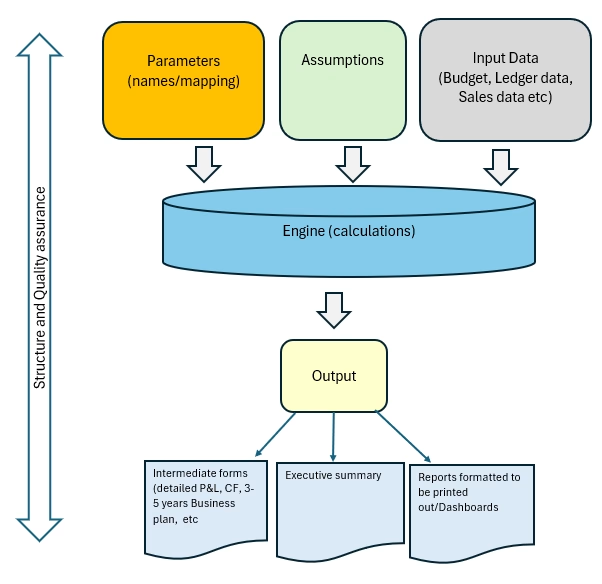
A well-designed Operational Financial Model is not just a spreadsheet-it is a structured system. Its strength lies in the logical flow from parameters and assumptions through inputs and calculations, ending with outputs and insights. The diagram below illustrates this architecture. It is important to underline that there is no single universal standard for financial models. Instead, what exists are best practices: proven methods that enhance reliability, clarity, and scalability while reducing costly mistakes. Poorly structured models often lead to errors, wasted time, and misinformed decisions. A robust architecture is therefore not a matter of aesthetics, it is essential for effective management.
The level of detail depends on the company’s size, complexity, and management needs. For some businesses, for instance, it is sufficient to model a percentage increase in revenue by product line or sector. For others, especially those in fast-moving or high-competition industries, revenue must be built on concrete prices for each product or category, with the flexibility to adjust those prices throughout the year.
At the very top, we start with parameters: the structural backbone of the model. These include elements such as time periods, currencies, entity and business units mappings, reporting categories and chart of accounts mapping and other unique identifiers.
Parameters ensure consistency across the model and allow updates to cascade automatically, avoiding manual errors. In other words, the parameters are Names which will be unique across all model.
Next come the assumptions, which represent the drivers of the business. Growth rates, pricing strategies, cost inflation, investment schedules, or financing terms; these inputs capture management’s expectations about the future. Clear documentation and separation of assumptions from hard data are essential so that scenarios can be tested transparently.
The third layer is input data, grounding the model in reality. This includes historical financials, sales and operational data, budgets, headcount information and other. Clean data imports and validation checks ensure the model reflects the actual state of the business.
At the core sits the calculation engine. Here, parameters, assumptions, and data converge. Revenue is built up by volume and price, costs are derived from operational drivers, CapEx and depreciation are scheduled, and debt amortization flows into the financial statements. Transparency and modularity are key, each section should be traceable and easy to audit.
Finally, we arrive at the outputs: the tangible results of the model. These include detailed financial statements (P&L, Balance Sheet, Cash Flow), executive summaries for decision-makers, and dashboards or reports tailored to different stakeholders. Outputs should not only present numbers, but also highlight insights: variances, key ratios, and scenario outcomes.
This layered architecture creates a model that is robust, flexible, and scalable. It allows finance teams to move from manual, reactive reporting towards proactive business partnering, where forecasts and scenarios can be updated quickly and reliably to support management decisions.
One of the most critical aspects of an Operational Financial Model (OFM) is the design of its forecast cycle. A model is only as valuable as the frequency and reliability with which it is updated.
The guiding principle is simple: the periodicity of the forecast should mirror the reporting cycle. Ideally, the updated forecast becomes an integral part of the management accounts; whether monthly, quarterly, or another agreed rhythm. This ensures that forecasts are not an afterthought, but fully embedded into the way performance is measured and discussed.
Ideally, an Operational Financial Model should be built with monthly detail extending 3–5 years forward. While some might argue that such granularity is excessive, in practice it provides two major advantages:
In other words, start detailed, then roll up - never the reverse.
A phrase I often use with my teams: “Mamma mia! No hard numbers!” A well-structured model must avoid static, hard-coded inputs. Instead, it should be driver-based and flexible from the very beginning, so that when circumstances change (as they always do), the model adapts without requiring structural surgery.
This flexibility ensures that management can rely on the same consistent framework for multiple years, whether they need a five-day cash plan, a rolling 18-month forecast, or a consolidated five-year strategy.
A robust forecast is not only about model design, it is also about the process and governance behind it. Without clear responsibilities and workflows, even the most sophisticated model will quickly lose accuracy and credibility.
In best practice, the FP&A team acts as the central owner of the forecast, while other departments provide inputs in their areas of expertise:
A practical way to embed this process without creating disruption is to integrate forecasting into the monthly closing routine. For example, during the analysis of budget vs. actual discrepancies, Finance can already collect from business owners the updated forecast for the next months. This way, the model is refreshed as part of the normal reporting workflow, avoiding the need for separate, time-consuming forecast updates that interfere with daily activities.
💡 Practical Suggestion:
This simple discipline dramatically improves the quality and realism of forecasts. It ensures that the OFM reflects the true trajectory of the business, rather than accumulating noise from reporting variances.
Even the most elegant model structure will collapse if the data feeding it is unreliable. A robust data pipeline ensures that inputs flow into the model efficiently, consistently, and with built-in checks that guarantee quality.
If the model is not fully integrated with an ERP or BI system, one of the most effective practices is to map the model’s categories to the Chart of Accounts or other accounting structures. This way, data can be imported or pasted directly into the model without manual reclassification.
In practice, I often use a simple but powerful method:
Each update of actuals should be stored with version identifiers (e.g., “Forecast v3.2 – September closing”). This provides transparency and traceability, avoiding confusion when comparing outputs across periods. A simple change log sheet within the model can capture who updated the data, when, and what assumptions were changed.
Data quality must be monitored, not assumed. The best practice is to include a separate validation sheet in the model where automated checks are run. Examples:
To make it user-friendly, these checks can be visualized with traffic-light indicators (green = correct, red = error, yellow = warning). This provides an instant signal if something is wrong.
A simple audit trail, even if just in Excel, helps track updates. At minimum, record:
This ensures the model can be reviewed or handed over without losing its integrity.
💡 Practical Suggestion: Always keep cross-reconciliations in the model. Even a simple variance check between the uploaded general ledger totals and the model’s aggregated outputs can save hours of error-hunting and prevent incorrect reports from reaching management.
The final layer of an Operational Financial Model (OFM) is the output - the part that management, investors, and other stakeholders actually see and use. A model without well-designed outputs risks becoming a black box: full of calculations but unable to communicate value.
Outputs should be ready to print, share, or distribute across internal channels without requiring extensive manual formatting. This is where the model evolves from being a technical finance tool into a true decision-support system.
In one of my organizations, we structured the OFM to produce:
This approach reduced preparation time, avoided inconsistencies, and ensured that everyone worked from the same version of the truth.
💡 Practical Suggestion: Always include validation checks within the outputs themselves, for example, a small note that confirms the balance sheet reconciles or that cash matches across statements. This avoids sending out reports that look polished but contain silent errors.
An Operational Financial Model (OFM) is far more than a spreadsheet, it is a management system. Built on clear parameters, realistic assumptions, reliable data pipelines, and transparent calculations, it delivers outputs that are ready to be used in decision-making. When designed correctly, the OFM becomes the backbone of forecasting, scenario analysis, and performance management.
The key takeaway is simple: the purpose of financial modelling is not only to report the past, but to prepare the future. Forecasting should not be reduced to a biannual exercise or a reactive activity. Instead, it must be embedded into the company’s governance and reporting cycle, continuously updated, and flexible enough to support both strategic decisions and operational needs: from multi-year planning down to weekly cash control.
By combining structure with discipline: parameters, governance, data quality, and outputs designed for distribution, Finance can transform the forecasting process from a time-consuming chore into a strategic enabler of insights, timeliness, and efficiency.
At FinDep Consult, we bring a world of expertise in building and implementing such models. We can design a best-in-class Operational Financial Model tailored to your company’s needs, or even train your finance team to build, maintain, and use it effectively. Whether your goal is to enhance forecasting accuracy, strengthen cash flow management, or empower management with faster insights, we can help you put the right financial modelling framework in place.
👉 Contact FinDep Consult to discover how we can bring FP&A and BI expertise to your business.
👤 About the Author
Anastasia Aleksenko, FCCA, Managing Partner at FinDep Consult. ACCA Fellow and CPA (Italy) with 25+ years in finance leadership, specializing in financial modelling, FP&A transformation, and operational financial control.
As a Finance professional, she has embraced the power of Financial Modelling, learning its tools and successfully implementing tailored solutions across different organizations. This unique combination of finance expertise and Financial Modelling competencies allows her to design FP&A functions that are not only results-driven but also fully data-enabled, helping companies improve performance and achieve their strategic objectives in a measurable, sustainable way.
In a world where business complexity increases every day and data are more available, and more important than ever, decisions must be based on facts, not on intuition or seniority. This is why SMEs need Business Intelligence to navigate complexity, transform data into actionable insights, and ensure that every decision is grounded in evidence rather than instinct.
Large corporations have already embraced this principle. They invest heavily in Business Intelligence (BI) systems and in building strong competencies, because they clearly see the immediate benefits. For them, data-driven decision-making follows a scientific method of analysis: collecting, processing, and interpreting data before acting on critical strategic choices. Their organizational structures are usually segmented, meaning that specialists focus on their specific functions. In such cases, FP&A plays a pure FP&A role, acting as the “customer” of Business Intelligence teams by defining requirements and consuming BI outputs.
For SMEs, the situation is different. Their main challenges are scalability, limited budgets, and cultural barriers. Decision-makers often assume that BI systems and advanced analytical competencies are “only for big companies.” They are partially right, resources are indeed more constrained. But that does not mean SMEs can afford to ignore the value of data-driven management. On the contrary, SMEs must also run their businesses effectively, respond to challenges in a timely manner, and achieve their objectives in a controlled and sustainable way.
This is exactly where FP&A professionals with BI skills come into play: they enable SMEs to combine financial insight with data-driven tools, ensuring that even smaller organizations can make decisions based on evidence, not instinct.
Financial Planning & Analysis (FP&A) has always stood at the intersection between numbers and strategy. Its mission has traditionally been to take financial results, analyze them, and provide management with a clear picture of how the company is performing against its objectives. In many SMEs, this role has historically been carried out through Excel spreadsheets and manual reporting. These tools are still valuable, but when uncertainty increases, competition intensifies, and financial pressure grows, spreadsheets alone are often too slow, too limited, and too fragile to support timely decision-making.
In today’s data-driven environment, FP&A cannot be confined to budgeting cycles or historical variance analysis. Its role has expanded into something far more dynamic:
This shift fundamentally changes how SMEs must think about FP&A. It is no longer a back-office function producing reports; it becomes a strategic partner. To fulfill this role, SMEs need to go beyond spreadsheets and embrace Business Intelligence tools and methodologies. BI allows FP&A to connect data from across the business, build a single source of truth, and deliver insights that are not only descriptive but also predictive.
In short, in a world where complexity and data availability are growing, FP&A provides the framework that allows SMEs to remain competitive and resilient, not by intuition, but by decisions firmly grounded in evidence.
Over the past decade, entirely new professions have emerged around data. Data Scientists work with both structured and unstructured information, applying advanced algorithms and machine learning to uncover hidden patterns and predict future outcomes. Data Analysts specialize in answering specific business questions: they collect, clean, and interpret datasets to provide clarity on particular issues. Business Intelligence Analysts, on the other hand, design systems and dashboards that give leaders real-time visibility into performance, enabling them to monitor and respond quickly.
These roles may come from diverse backgrounds: statistics, computer science, or business, but they all share a common foundation: data is their raw material.
FP&A professionals are not different in this respect: they too depend on data. But their contribution goes beyond pure analysis or visualization. What distinguishes FP&A is their ability to connect financial data directly with business strategy. They are the bridge between the operational side of the company and the financial narrative that drives strategic choices.
Bridging this gap means that FP&A does much more than review numbers in isolation. Like Data Analysts, they must work with structured data from multiple systems: ERPs and accounting platforms for financial flows, CRMs for customer and sales insights, HR systems for workforce metrics, and operational tools that track production, logistics, or service delivery. By bringing these datasets together, FP&A is able to explain business performance, validate results, and even anticipate outcomes before they appear in the financial statements.
But the role doesn’t stop at structured data. Often, FP&A must also interpret unstructured information: PDF reports, textual notes, market studies, or external economic data that add valuable context to the numbers. This combination allows them not only to analyze what has happened, but to predict what might happen next and prepare the organization accordingly.
Finally, as with Business Intelligence specialists, FP&A must ensure that insights are not locked in complex models or hidden in spreadsheets. Their mission is to communicate relevant information clearly to the business and its stakeholders; answering questions, guiding decisions, and ensuring that performance remains aligned with strategic objectives. Dashboards, reports, and presentations are not ends in themselves, but tools that enable managers to understand, act, and steer the company toward its goals.
In this sense, FP&A is not a competitor to Data Scientists, Data Analysts, or BI specialists. Instead, it is a role that integrates elements of all three: analytical rigor, technical fluency, and business orientation. And because their perspective is anchored in both finance and operations, FP&A professionals are uniquely positioned to ensure that data becomes not just information, but a driver of decisions that create real business value.
In many small and medium-sized enterprises (SMEs), Business Intelligence is still seen as something that belongs either to the IT department or to external consultants. The assumption is that BI is too technical, too expensive, or too far removed from day-to-day financial management. Yet, placing BI capabilities directly within FP&A opens opportunities that SMEs cannot afford to ignore.
The first advantage is business relevance. FP&A professionals understand the company’s financial DNA: the drivers of revenue, the structure of costs, and the levers that impact profitability. When they are the ones shaping BI systems and dashboards, the outputs are not generic reports but tools directly aligned with business priorities. This ensures that every visualization, every metric, and every model speaks the language of performance and strategy.
Secondly, embedding BI within FP&A dramatically accelerates decision-making. Instead of waiting for IT teams to extract data or for external consultants to prepare reports, managers can rely on financial insights delivered in real time. The result is agility: leadership can respond quickly to market changes, emerging risks, or new opportunities, armed with accurate information.
Another crucial capability is scenario planning and forecasting. BI tools, when integrated with FP&A models, allow SMEs to run “what-if” simulations instantly. Leaders can see how a change in sales volumes, pricing, or supply costs would impact margins and cash flow, long before those shifts appear in the accounts. This forward-looking approach transforms uncertainty into preparedness.
For SMEs, which often operate with limited resources, BI within FP&A also becomes a tool for resource optimization. By analyzing data holistically, FP&A can identify inefficiencies, highlight underperforming areas, and recommend how capital and talent should be reallocated to maximize value creation.
Another important benefit is the avoidance of additional specialist costs. In large organizations, it is indispensable to have dedicated Business Intelligence specialists, because the scale and complexity of data require full-time roles focused only on BI. But in SMEs, where resources are tighter, having FP&A professionals skilled in BI means there is no need to invite or invest in an additional BI specialist. A single function can combine financial expertise with analytical capabilities, ensuring that BI is both cost-effective and directly relevant to business needs.
Finally, there is the question of scalability. SMEs may begin small, but growth brings complexity. BI systems designed and managed by FP&A evolve with the business, ensuring that decision-making processes remain robust and reliable as the company expands into new markets, products, or geographies.
In essence, integrating BI into FP&A is not about adding more technology for its own sake—it is about giving SMEs the ability to make better, faster, and smarter decisions. It transforms FP&A from a reporting function into a strategic enabler, ensuring that financial insight becomes the foundation for resilience and growth.
For SMEs, adopting BI within FP&A does not need to be a massive, costly transformation. In fact, the journey can be taken step by step, with tools and approaches that are both practical and accessible.
The natural starting point is Excel, still the backbone of most FP&A work. Excel remains indispensable for modeling and quick analyses, but it has limitations in terms of scalability, visualization, and collaboration. The next step is to evolve into dedicated BI solutions such as Microsoft Power BI, Tableau, or Qlik. Among these, Power BI stands out for its affordability: licenses start from around 10–20 euros per user per month, making it a realistic option even for smaller organizations. With such tools, SMEs can move from static spreadsheets to interactive dashboards, gaining a dynamic view of their business.
But tools alone are not enough. To make BI valuable, FP&A must define the key business drivers—the metrics that really matter. Cash flow, working capital, customer acquisition costs, and operational KPIs are not just numbers; they are the pulse of the business. Dashboards should be designed around these drivers, telling the story of performance and guiding management decisions.
A further step is to automate data collection. Too often, valuable time is wasted in exporting, cleaning, and reformatting data. By connecting BI systems directly to ERPs, CRMs, HR, and sales platforms, FP&A can eliminate repetitive manual tasks and dedicate more time to analysis, forecasting, and strategic support.
This approach can be transformative in practice:
Naturally, making this happen requires skills. An FP&A professional with solid BI competencies brings immense value, but such profiles are still relatively rare and therefore command higher salaries. For many SMEs, the alternative is to partner with advisory firms specialized in FP&A and BI. Companies like FinDep Consult can design tailored solutions, set up FP&A functions, implement BI tools, and train internal staff to ensure long-term sustainability. This project-based approach is often more cost-effective: the SME gains access to expertise, best practices, and training without committing to a permanent high-cost hire. If needed, ongoing support can be provided to maintain and further develop the systems.
Small and medium-sized enterprises (SMEs) face the same business complexity as large corporations, but with fewer resources at their disposal. This makes it even more critical for them to base decisions on facts rather than intuition or hierarchy. By integrating Business Intelligence into FP&A, SMEs gain the ability to transform financial and operational data into actionable insights, anticipate risks, and guide their growth in a controlled and sustainable way.
The evidence is clear: BI-driven FP&A is not a luxury reserved for big players. It is a necessity for SMEs that want to remain competitive, resilient, and profitable in today’s fast-changing environment. With the right tools and competencies, FP&A moves beyond reporting the past and becomes the co-pilot of the business, actively shaping its future.
This is exactly where FinDep Consult can make a difference. Our expertise lies in combining financial knowledge with advanced FP&A and BI solutions, always oriented toward the real needs of the client. We design tailored frameworks, implement the right tools, and train internal teams to ensure that insights do not remain theoretical but deliver measurable value. For SMEs, our interim management assignments represent a pragmatic compromise: access to senior expertise and advanced methods without the long-term fixed cost of a permanent hire.
In short, working with FinDep Consult means having a partner that brings clarity where there is complexity, builds capabilities where there are gaps, and helps transform data into a true driver of business performance.
👉 Contact FinDep Consult to discover how we can bring FP&A and BI expertise to your business.
👤 About the Author
Anastasia Aleksenko, FCCA, Managing Partner at FinDep Consult. ACCA Fellow and CPA (Italy) with 25+ years in finance leadership, specializing in financial modelling, FP&A transformation, and operational financial control.
As a Finance professional, she has embraced the power of Business Intelligence, learning its tools and successfully implementing tailored solutions across different organizations. This unique combination of finance expertise and BI competencies allows her to design FP&A functions that are not only results-driven but also fully data-enabled, helping companies improve performance and achieve their strategic objectives in a measurable, sustainable way.
FP&A has undergone a profound shift in recent years. What was once a role largely confined to reviewing historical results, identifying variances, and producing reports has now become a forward-looking, strategic function. FP&A now goes beyond delivering data-driven insights to support sharper, more informed decisions; it also plays a key role in keeping processes aligned with the company’s broader vision and long-term objectives
The end goal of FP&A is the same everywhere: to connect numbers with strategy and ensure that resources are used effectively. What changes, however, is the way this goal is achieved. The tools, methods, and even the skills required can differ greatly depending on the industry, the stage of growth, and the business model in play.
In the case of SaaS companies, and especially those operating with AI-driven cloud solutions, FP&A takes on very specific characteristics. This article will look at the technical aspects that make FP&A in SaaS both challenging and uniquely valuable.
What sets SaaS companies apart from other service providers is the subscription-based, recurring revenue model that underpins their business. Instead of one-off transactions, value is built over time through long-term customer relationships, established via subscriptions and different types of contracts, such as:
For this type of business, it is no longer sufficient to simply forecast revenue, compare actuals against budget, or perform routine cost analysis by element or by month. To deliver real value, FP&A must go further—designing, monitoring, and interpreting a set of SaaS-specific metrics that act as the true drivers of both performance measurement and forward-looking predictions.
One of the most important metrics in SaaS is MRR (Monthly Recurring Revenue). It helps normalize and forecast subscription revenue in a consistent way each month. For further reading on MRR—what it is, why it's important, and how it's calculated—you can refer to this detailed guide from the Corporate Finance Institute: What is Monthly Recurring Revenue (MRR)?
Other key SaaS metrics include:
Together, these metrics form the backbone of financial planning in SaaS. They not only guide forecasting and variance analysis but also provide early signals on growth efficiency, scalability, and long-term value creation.
One of the key complexities in SaaS lies in the accounting treatment of revenues and costs. Unlike traditional businesses where revenue is often recognized at the point of sale, SaaS companies operate under a subscription or usage-based model, which requires careful alignment with accounting standards (such as IFRS 15 or ASC 606).
In short, accounting treatment defines the financial framework within which FP&A operates. Without mastering it, FP&A risks misinterpreting results or miscommunicating performance drivers to management and investors.
The role of FP&A in SaaS goes far beyond spreadsheets. To manage the complexity of recurring revenues, high customer acquisition costs, and dynamic churn patterns, FP&A teams rely on a combination of tools and processes that allow them to integrate financial data, operational metrics, and business drivers into a single planning framework.
Imagine a SaaS company offering an AI-powered communications platform:
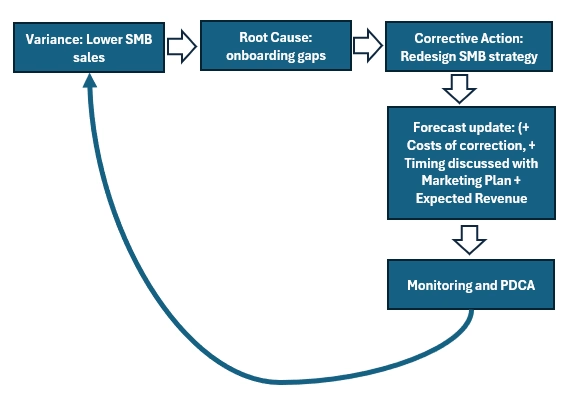
A simple response would be to reallocate marketing spend from SME to enterprise, which might improve ROI on CAC in the short term. But FP&A pushes further, investigating the root causes behind the SME underperformance. Analysis shows that:
Based on these insights, management decides on a twofold corrective action:
This example illustrates that FP&A’s role is not limited to reporting deviations. It is about connecting financial signals to operational drivers and ensuring that corrective actions address the real causes, not just the symptoms.
The above image shows how FP&A moves beyond reporting to action: from identifying a variance, through root cause analysis and corrective action, to updating the forecast with costs, timing, and expected revenue. Continuous monitoring and PDCA close the loop, ensuring forecasts stay aligned with business reality.
FP&A in SaaS is fundamentally different from other industries. While the core objective of aligning financial performance with strategy remains the same, the methods, metrics, and tools must reflect the realities of a subscription-driven, customer-centric business model. Forecasting cannot stop at revenue projections or cost allocations — it must incorporate SaaS-specific KPIs, account for revenue recognition rules, and translate operational signals into forward-looking financial insights.
Ultimately, modern FP&A is not about explaining the past but about shaping the future, ensuring that corrective actions are tied to root causes and reflected in updated forecasts. In SaaS, this means FP&A becomes a true strategic partner: guiding investment decisions, improving efficiency, and enabling scalable, sustainable growth.